Why is energy storage important for the global energy transition?
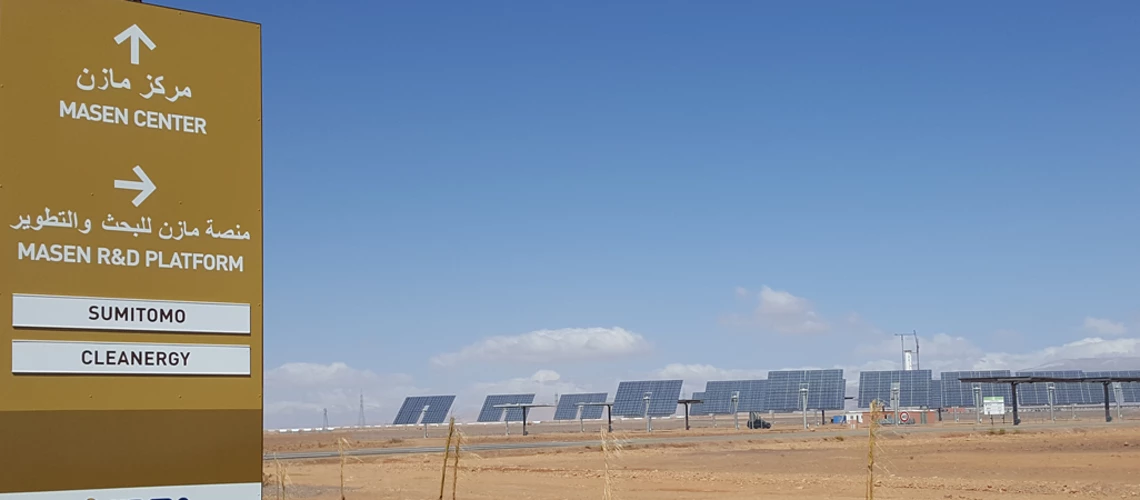
A patch of desert in southeastern Morocco may hold the key to achieving the world’s net-zero ambitions. It is home to a research center on renewable energy storage built by Masen, Morocco’s Agency for Sustainable Energy, where new methods of generating and storing solar power are being studied and tested. The World Bank’s ESMAP has partnered with several innovative private companies to support this research center, which is specifically designed to meet the energy storage needs of developing countries.
Why is this so important? Energy storage is key to ensuring a continuous supply of renewable energy for power systems—even when the sun is not shining and the wind is not blowing. It provides a solution for achieving flexibility, improving grid reliability and power quality, and enabling the scaling up of renewable energy. However, most energy storage systems developed to date are not suited to the specific conditions and use cases of developing countries.
Energy storage systems do not follow a one-size-fits-all approach, and the needs of developing countries are often overlooked. These countries typically have weak grids, characterized by poor supply security due to a combination of insufficient, unreliable, and inflexible generation capacity; underdeveloped or non-existent grid infrastructure; lack of adequate monitoring and control equipment; and insufficient maintenance. In this context, energy storage can help enhance reliability. When deployed alongside variable renewable energy sources such as wind and solar, it can help replace costly and polluting fossil fuel-based electricity while improving supply security. Storage can also help delay or avoid the construction of new grid infrastructure.
That is why the Masen test site—also known as a testbed—is located in a harsh desert environment. It not only simulates the climatic conditions where storage systems will be deployed, but also provides testing conditions for their end-use applications, such as delivering low-voltage electricity at night for critical needs like local hospitals.
These testbeds are being developed with such conditions, needs, and use cases in mind. The idea is that with properly tailored storage systems, the true potential of renewable energy can be realized, helping the world move closer to meeting its net-zero commitments.
Scaling up energy storage
It is increasingly clear that global deployment of renewable energy depends on scaling up energy storage. This is a critical frontier that must be overcome to achieve net-zero emissions and universal access to clean energy by 2030. For example, Morocco aims to have 52% of its installed capacity from renewable sources, but this target cannot be achieved without energy storage systems to provide the flexibility needed for large-scale renewable generation.
Solar PV is currently the cheapest source of electricity, but without storage, it cannot be fully utilized. The only way to integrate more solar power into the grid or into national capacity expansion plans is through storage systems that can balance supply and demand.
The development of renewable energy has occurred in two distinct phases. From 2010 to 2020, the overall cost of renewable energy systems—particularly solar and wind—fell below or matched that of fossil fuels in most countries, driving a surge in new projects. However, it has since become clear that solar and wind projects place significant pressure on national grids, which can often only absorb about 30% of the newly generated renewable energy.
Beyond new storage technologies, energy storage systems also require an enabling environment for financing and deployment, which calls for broad support from multiple stakeholders. ESMAP has established and convened the Energy Storage Partnership (ESP), aiming to finance 17.5 gigawatt-hours (GWh) of battery storage by 2025—more than triple the 4.5 GWh currently installed across all developing countries. So far, the program has mobilized $725 million in concessional funding and will deliver 4.7 GWh of battery storage (ongoing projects), with an additional 2.4 GWh in the pipeline.
ESP is currently working to develop a framework for hybrid power purchase agreements (PPAs) combining solar and battery storage. PPAs are the backbone of all power projects, as they define, for example, who will buy the electricity and at what price—providing the certainty needed to secure financing.
Creating this PPA framework as a global public good will enable systematic deployment of storage systems worldwide, moving beyond a project-by-project approach. It will also unlock significantly larger volumes of financing for the sector, particularly from the private sector.
Mainstreaming energy storage systems in developing countries will be a game changer. It will accelerate broader access to electricity while enabling greater use of renewable energy, thereby helping the world achieve net-zero carbon emissions.
The Energy Storage Partnership held its 9th Partners Meeting and Stakeholder Forum from June 26–30, 2023, with participation from over 40 countries. We extend our thanks to the host institutions—the Government of the United Kingdom, through the Department for Energy Security and Net Zero, and the Foreign, Commonwealth & Development Office (FCDO)—as well as Loughborough University. This marked the first time the ESP Stakeholder Forum was held in the United Kingdom.
Author: Demetrios Papathanasiou
CARBON CREDIT TRADING PLATFORM ASEAN (CCTPA)
Address: Léman – 20 Truong Dinh, Xuan Hoa Ward, Ho Chi Minh City
Hotline: (+84) 28 6272 5889
Email: info@aseancarboncredit.com