Joining the carbon market: “A game you can’t afford to refuse”
The carbon market is a global arena that Vietnamese businesses can hardly opt out of. While there are many challenges for participants, the opportunities are equally significant.
Carbon market to be operational by 2029
Speaking at the seminar “Solutions to Promote Business Participation in the Carbon Market in the Industry and Trade Sector” on the morning of September 4, Mr. Hoang Van Tam from the Department of Energy Efficiency and Sustainable Development (Ministry of Industry and Trade) stated:
“Vietnam is actively preparing for the official operation of the carbon market by 2029.”
The period from now until 2028 will serve as a preparation phase, during which ministries, sectors, and local authorities will develop the legal framework, infrastructure, and technical conditions necessary for market operation.
One of the key objectives is to establish regulations related to greenhouse gas emission reductions and the development of high-quality carbon credits. The Ministry of Industry and Trade is also working to enhance business capacity, helping enterprises better understand regulations and prepare for participation in the carbon market.
Cement industry under pressure to go green
As a high-emission sector, the cement industry faces significant pressure to transition toward greener production technologies.
Carbon emissions in cement production exceed 800 kg per ton of cement, while clinker production emits around 900 kg CO₂ per ton, depending on the plant.
Over the past five years, the cement industry has emitted an average of 62–70 million tons of CO₂ annually. Notably, clinker production accounts for more than 90% of total emissions per ton of cement.
Assoc. Prof. Dr. Luong Duc Long, Vice Chairman and Secretary General of the Vietnam Cement Association (VNCA), noted:
“Currently, more than 60 cement plants nationwide that produce clinker are included in the list of enterprises subject to government-regulated carbon emission quotas. Businesses are increasingly aware of the issue and have made varying levels of preparation to comply with new regulations, aiming to reduce carbon emissions in production.”
Encouragingly, some companies have adopted alternative fuels to replace fossil fuels, such as biomass and industrial or municipal waste (e.g., from leather, textiles, or household waste). More than 10 cement plants have already begun using alternative fuels, replacing approximately 35–40% of coal consumption.
However, according to Mr. Long, emission calculations in the cement industry are still largely technical and have not yet been fully codified into law. He recommended the development of standardized tools and methodologies for measuring, calculating, and evaluating greenhouse gas emissions to provide a clear basis for businesses.
A “Game” businesses cannot avoid.

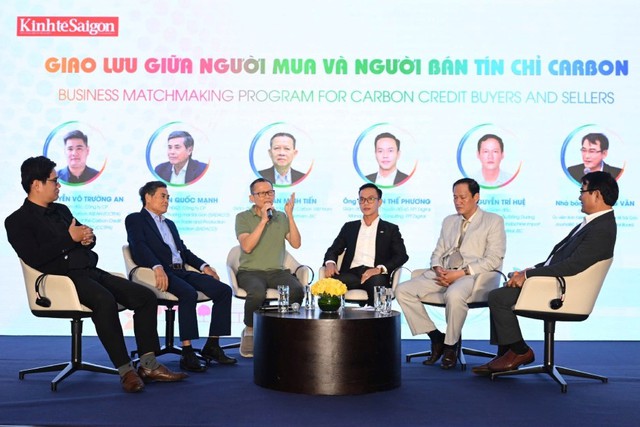
Mr. Nguyen Vo Truong An, Deputy CEO of the ASEAN Carbon Credit Trading Platform Joint Stock Company (CCTPA), emphasized:
“The growing attention to carbon credits and the carbon market has raised awareness among businesses about the urgency of transforming production and gradually participating in the market.”
This is a strategic step that not only helps businesses mitigate environmental risks but also enhances their adaptability to increasingly stringent global regulations.
“The carbon market is an international playing field that Vietnamese enterprises cannot afford to ignore. While there are many challenges, the opportunities are immense,” Mr. An stated.
Recently, many businesses—especially large corporations and FDI enterprises—have begun prioritizing green strategies in their operations.
“In a market full of potential opportunities but also significant challenges, learning from international experience is crucial. Countries with well-established carbon markets offer valuable lessons for Vietnam.
For example, in December 2023, Indonesia launched the first government-operated carbon credit exchange in Southeast Asia. In the near future, more countries are expected to follow. Therefore, international knowledge exchange is essential.”
Key challenges in developing the carbon market
Mr. Nguyen Vo Truong An identified four major challenges in implementing Vietnam’s carbon market:
- Human resources
- Methodologies
- Financial capacity
- Machinery and technology
In terms of methodology, both businesses and even experts are still uncertain about how the market will operate in practice. Financially, green transition technologies and emission reduction solutions require substantial investment—significantly higher than conventional technologies.
Regardless of whether the market is mandatory or voluntary, businesses must first understand their emission levels—where emissions occur within their processes—and quantify them with concrete data in order to develop effective solutions.
Experts also emphasized that, in the current context, international cooperation is key to unlocking Vietnam’s carbon market.
CARBON CREDIT TRADING PLATFORM ASEAN (CCTPA)
Address: Léman – 20 Truong Dinh, Xuan Hoa Ward, Ho Chi Minh City
Hotline: (+84) 28 6272 5889
Email: info@aseancarboncredit.com