Businesses need to be more proactive in the carbon credit market
According to experts, the carbon credit market is currently beginning to take shape, but it remains in a challenging context where businesses are still relatively “passive.” Many transactions are conducted through bilateral contracts, while a centralized exchange has yet to be established.
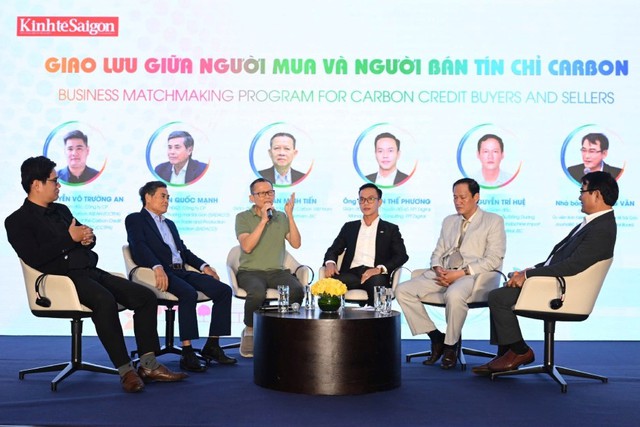
This was the key topic discussed during the session “Networking Between Carbon Credit Buyers and Sellers,” held as part of the Green Economy Forum 2024 on September 19 in Ho Chi Minh City.
Assessing the carbon credit market, Mr. Nguyen Vo Truong An, Deputy CEO of the ASEAN Carbon Credit Trading Platform Joint Stock Company (CCTPA), stated that Vietnam is significantly lagging behind the global market. At present, although the market is starting to emerge, it still faces numerous challenges, and businesses remain “quite passive.”
Accordingly, the carbon credit market began to emerge as early as 2017, but was largely driven by foreign investors who “reserved” credits, even making advance payments before the credits were officially verified. To date, many transactions are still conducted via bilateral agreements without a formal exchange, making the market resemble brokerage activities.
Mr. An also noted that carbon credit prices in Vietnam remain relatively low, partly due to this passive approach. Businesses have not proactively sought buyers to negotiate pricing, nor have they developed high-quality projects. While some companies have started investing in carbon credit initiatives, most efforts are still limited to technology adoption.
Mr. Nguyen The Phuong, Director of Digital Transformation Consulting at FPT Digital, emphasized that the first step for businesses is to adopt tools for greenhouse gas inventory in line with international standards. Emissions assessment helps companies understand their current position—whether they exceed thresholds or still have room to transfer credits to others. This data serves as the foundation for third-party verification and subsequent issuance of carbon credits.
Similarly, Mr. Tran Minh Tien from Netzero Carbon Vietnam, a consulting firm involved in carbon credit projects including rice cultivation, highlighted the need for professional consultants to measure emissions and determine a company’s carbon footprint. Following that, projects must be developed in accordance with recognized market standards.
Mr. Nguyen Vo Truong An added that leading standards today place strong emphasis on robust methodologies across various sectors, including forestry, land use, agriculture, energy, and carbon capture.
“As long as a project is scientifically designed and complies with these methodologies, it will be eligible to generate carbon credits,” Mr. An recommended as a way for businesses to enhance their ability to issue carbon credits.
Source: Báo Điện tử Chính phủ
CARBON CREDIT TRADING PLATFORM ASEAN (CCTPA)
Address: Léman – 20 Truong Dinh, Xuan Hoa Ward, Ho Chi Minh City
Hotline: (+84) 28 6272 5889
Email: info@aseancarboncredit.com